How Bambu Lab camera protocols work in Printer Tools
Bambu Lab does not expose every stock camera through one universal stream. Depending on the printer family, Printer Tools may use a secure RTSPS stream or the printer’s TCP JPEG feed. The app chooses the transport from the detected printer model rather than asking the user to guess a URL.
Knowing that split helps explain why a serial-number correction can fix Live View and why instructions for one Bambu family may be wrong for another.
All your 3D printers in one dashboard
Monitor Bambu Lab, Klipper, OctoPrint, Creality, Snapmaker, Anycubic, Flashforge, Elegoo, and Prusa printers from one app
Available on Android, iPhone, iPad and Mac, with Apple Watch and Wear OS companion apps plus optional remote access through VPN, OctoEverywhere or Obico
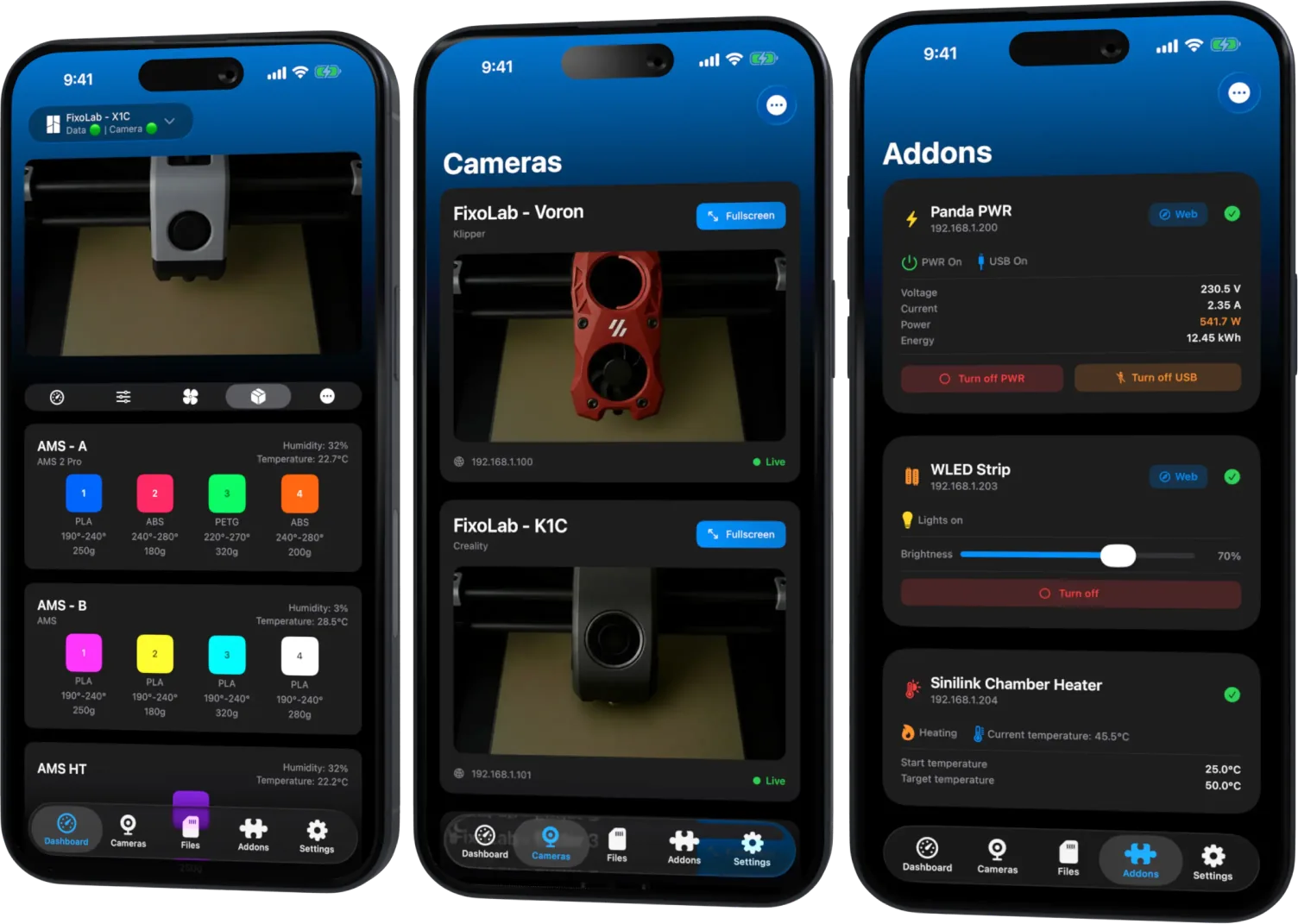
Native cameras are added with the printer
When you add a supported Bambu Lab printer, Printer Tools stores the address, serial number and LAN Access Code needed for its local services. The camera appears as the printer’s native Live View. You do not need to add it again as an external RTSP camera.
External camera setup is for a separate IP camera pointed at the printer. It does not replace the protocol chosen for the built-in camera.
Secure RTSPS camera families
Newer Bambu families can expose the main monitoring stream over RTSPS. Printer Tools builds the secure local stream with the saved printer information and opens it through its native camera stack.
On models such as X2D and the H2 family, enable Settings > Network > LAN Only Liveview if the camera port refuses the connection. Full LAN Only mode is not required.
An RTSPS failure can be caused by an incorrect serial, stale access code, blocked camera port, changed IP address or printer-side Liveview permission. It is not fixed by entering a public RTSP URL from a different model.
TCP JPEG camera families
Other Bambu printers expose images through a local TCP JPEG service. Printer Tools connects to that service and extracts the image frames for Live View.
The refresh rate and visual smoothness are determined by what the printer provides. A TCP JPEG feed should not be described as WebRTC or converted to RTSPS. If telemetry works and this feed fails, verify model detection, address, code and local reachability.
Why the serial number matters
The serial prefix is one signal used to recognize the printer family. If the model is misidentified, the app can attempt the wrong transport or port. Always enter the complete printer serial exactly as displayed.
Printer Tools updates its model mapping as Bambu introduces variants. Use a current app version before concluding that a new serial family is unsupported.
Camera access and cloud access are separate
Printer Tools reads the stock camera directly over the reachable local network. It does not retrieve the stream from a Printer Tools cloud server. The printer can still remain connected to Bambu Cloud and Bambu Handy.
The separate LAN Only Liveview permission enables local camera access without requiring full LAN Only mode. Do not expose the camera port directly on the public internet. Use a trusted VPN if remote local-network access is needed.
Diagnose the failure by layer
- Confirm printer telemetry and the current IP address.
- Verify the full serial and LAN Access Code.
- Check LAN Only Liveview on models that expose it.
- Remove guest-network isolation or blocking VLAN rules.
- Reopen Live View and capture a fresh encrypted log.
If the stream opens but pauses, focus on Wi-Fi quality, resolution and buffering. If the connection is refused immediately, focus on printer permission, model routing and port reachability.
Continue with how to reduce camera latency for a stream that connects but performs poorly.
Frequently asked questions
Can I choose RTSPS manually for any Bambu printer?
No. Printer Tools uses the transport supported by the detected model.
Is the built-in camera an external-camera entry?
No. It belongs to the saved printer and uses that printer’s local credentials and protocol.
Does a smoother protocol create a higher frame rate?
No. The printer determines what its stock camera provides. The app cannot invent frames that are not sent.
Should I share the generated stream URL?
No. It can contain sensitive local connection information. Use encrypted logs for support.
All your 3D printers in one dashboard
Monitor Bambu Lab, Klipper, OctoPrint, Creality, Snapmaker, Anycubic, Flashforge, Elegoo, and Prusa printers from one app
Available on Android, iPhone, iPad and Mac, with Apple Watch and Wear OS companion apps plus optional remote access through VPN, OctoEverywhere or Obico